Today we’re releasing new Greptile review tiers: Plus and Apex.
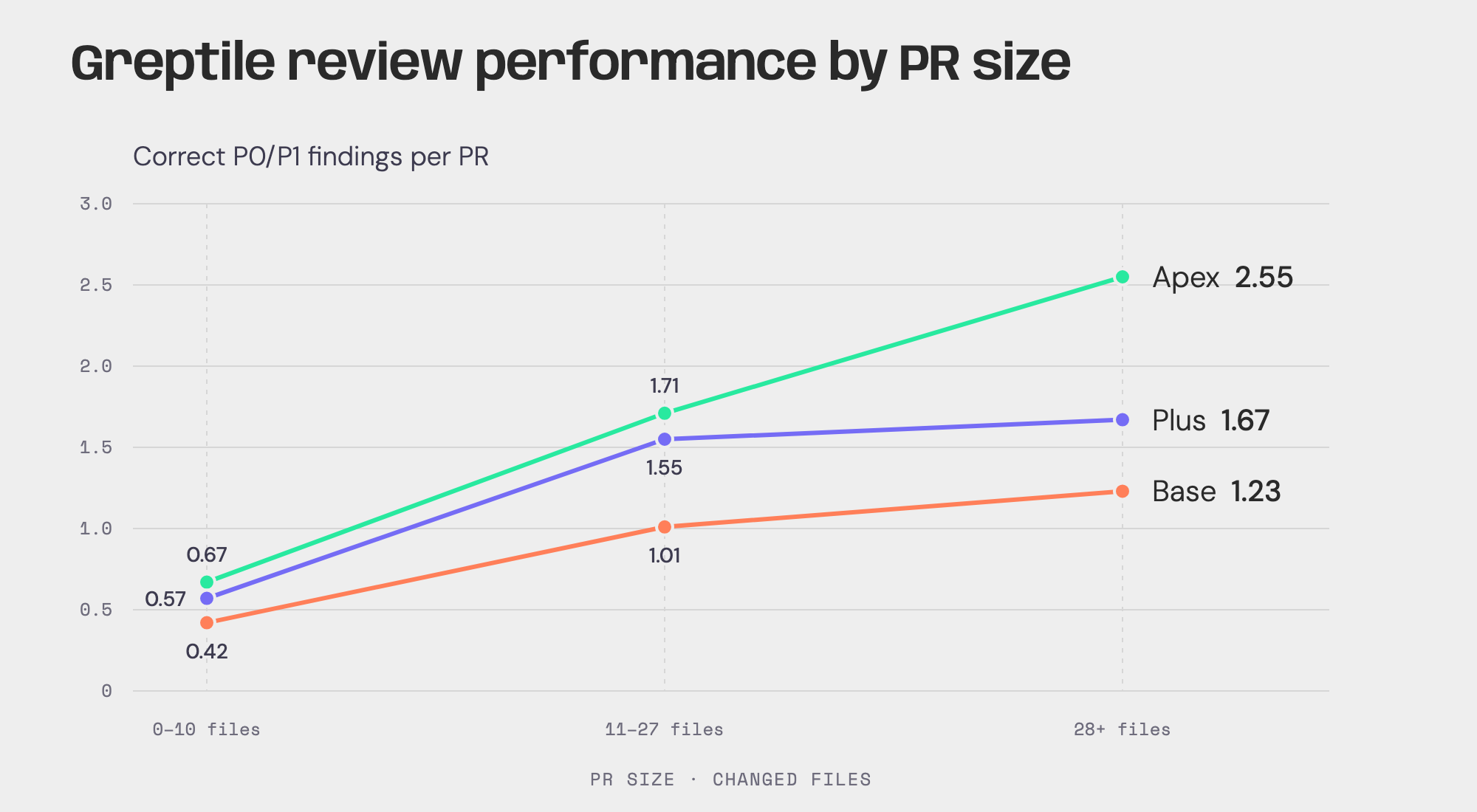
With the higher review tiers, each review has more time to run subagents and tasks in parallel, better understand the PR, and catch more bugs.
- Base (1 credit): Thorough code review with full codebase context.
- Plus (3 credits): A deeper review for PRs that need extra scrutiny.
- Apex (10 credits): Our most intensive review for large, complex PRs.
Base, Plus, Apex head to head
We ran Plus and Apex against one of our strongest examples, a PR in celestia-core, to benchmark quality. The PR adds a limit on how many signatures a node accepts from peers while syncing blocks. This example already had a strong Base review, but serves to illustrate how Plus and Apex go deeper when looking for bugs.
- All three tiers caught that most kinds of evidence skip the new limit. This bug is visible in the changed function.
- Plus and Apex also caught that the check uses a lot of memory before it runs. A peer can send about 120 MB that expands to over 1 GB. Finding this meant reading generated code most reviewers skip and working out the memory math.
- Apex also caught that the limit is too strict for some valid blocks. On a chain with large evidence limits, a syncing node can get stuck. Finding this meant reading consensus settings outside the PR and building a valid block that breaks the limit. Apex also flagged a gap in the tests.
Apex changed how we do PRs at Greptile
When running Apex at Greptile, it caught so many bugs that we changed how we run deploys.
Apex now runs on all large PRs before they get to the prod deploy stages, and merges to prod are smaller and more frequent.
You can switch to Plus or Apex here, set rules to automatically use either tier for large PRs or changes to high-risk code here.